Wednesday, 26 March 2014

Visit to the Museo de Bellas Artes

Tuesday March 25 was cloudy and cool with a high of about 17C.  We are really missing the sun and warmth of Santiago.  Valpo's climate is a Mediterranean one, but locals say it is cooler than it usually is at this time of year.  We decided to visit the Museo de Bellas Artes (Museum of Fine Arts).  We walked down the hill and headed into town.

The last few days we have noticed a number of teenagers in semi-dress, without shoes, and all coated with paint and goop in their hair.  We asked Boris, the chef, about this on Monday.  He said that they are freshman at university who have paint and other stuff thrown at them as well as their shoes taken from them by senior students.  They then have to go downtown and get money, which is used by the upper year students to throw a big party.  This hazing seems to be an ongoing event in the city this week.

Getting hazed

We took the El Peral ascensor to Cerro Alegre where the Museo de Bellas Artes is located.

 Looking up at the ascensor

                                     Turnstile where someone collects your 100 pesos (20 cents CAN)


The Museum of Fine Arts is located in a beautiful rambling art nouveau building called Palacio Baburizza.  The building was built for the Zanelli family in 1916, and then purchased in 1925 by Pascual Baburizza (1875-1941), who came to Chile from Croatia  in 1892.  Barburizza became a businessman and made a fortune in the nitrite business. He bequeathed his collection of over 96 paintings to the State when he died in 1941.  His former residence became an art gallery in 1971 and now houses about 250 pieces of art.  In addition to his European collection, there are a number of works by Chilean artists including scenes of Valparaiso, which came from another gallery that was destroyed in the 1906 earthquake.  The collection was interesting, most works done in the late 19th century and early 20th century, although there were some more contemporary pieces in the later rooms.

Palacio Baburizza


                                                   Beautiful details on the outside of the Museum
Restored room with paintings
Vista de Florencia by Louis Marie Desire- Lucas  (1869-1949)

There was a lovely painting by Eugene Louis Boudin, one of the first French landscape painters to paint outdoors.
En la Playa de Trouville by Eugene Louis Boudin (1824-1898)
Another restored room with paintings and large windows
La Prima Donna by Ulises Caputo (1872-1948)

There were a couple of portraits of Pascual Baburizza done by a Hungarian artist Rudolf Pintye, who moved to Chile in 1931.


The museum was closed for 15 years, and underwent an extensive restoration.  It just reopened in 2012.  The restoration was beautifully done and it is a lovely small museum to wander through.
Beautiful Gobelin tapestry and marble fireplace
Antiguo Muelle de Valparaiso 1882 by Thomas Jaques Sommerscales (1842-1927)
We both liked the following painting of the boardwalk in front of the Atkinson block in Valpo, which we had just walked by the other day.
El Paseo Atkinson 1896 by Alfredo Helsby (Chileno 1862-1933)
Interspersed with the rooms with paintings were restored rooms with art deco and art nouveau furniture.
Shower stall detail in Art Deco bathroom
Art Deco bathroom with Italian marble

Wonderful old fireplace
The museum had a number of paintings by Camilo Mori [1896 (Valporaiso) - 1973 (Santiago)], the son of an Italian immigrant who studied at the School of Fine Arts at the University of Chile in 1914.  He was subsequently sent to study in Europe by the Chilean government.  He was influenced by Picasso and Cezanne, whom he met in Paris. On his return to Chile he became one of the founding members of the Grupo Montparnasse, which helped bring the new European painting trends to Chile.  Mori was later sent by the Chilean government to direct the studies of a group of young painters known as the Generation of 1928, in which 26 of the most outstanding young Chilean artists were sent to study in Paris for five years.
El Circo by Camilo Mori (Chileno 1896-73)
The last room had a number of contemporary sculptures.  The following photo of a sculpture done in 1975 with a bound man in front of three judges is telling.
El Juicio by Mario Irarraz Abal 1975

We took a picture of the port from the boardwalk in front of the museum.  Lots of low lying clouds.  We like looking out at the Chilean fleet in the harbour and the 43 hills of Valparaiso.
                                                           View from in front of the Museo

We walked further into Cerro Alegre checking out the small shops and colourful street art.
Art + Believe
We stopped for a late afternoon sandwich and coffee at La Coco.  Very whimsical patio.  It was very relaxing.
Patio at La Coco
We headed back up the hill to our B&B for dinner.

Tuesday, 25 March 2014

Cooking class in Valpo!

Monday March 24 was another socked in foggy day.  It was cool (around 17C), but OK for walking.  There was a 6.2 earthquake in northern Chile at around 8:00 a.m.  One of the guests noticed it and Alano thought he felt something.  I always seem to miss the action.

We had signed up for a cooking class with Chilean Cuisine, recommended in our guidebook.  We were to meet our chef, Boris, at 4:00 p.m. at a cafe near Plaza Sotomayer downtown.

We walked downtown at about 1:00 p.m. and went to the area near Plaza Anibal Pinto, where we had met our Free Tour last week.  We took a few photos of the 'hood, hung out and watched the micro buses (tons of these private busses in the city), and the 60 plus year old trolleys.

The tin covered houses are quite common in Valpo-they apparently have a bit of give when there are earthquakes.

Tin covered homes
Looking up the ascensor Reina Victoria 1902
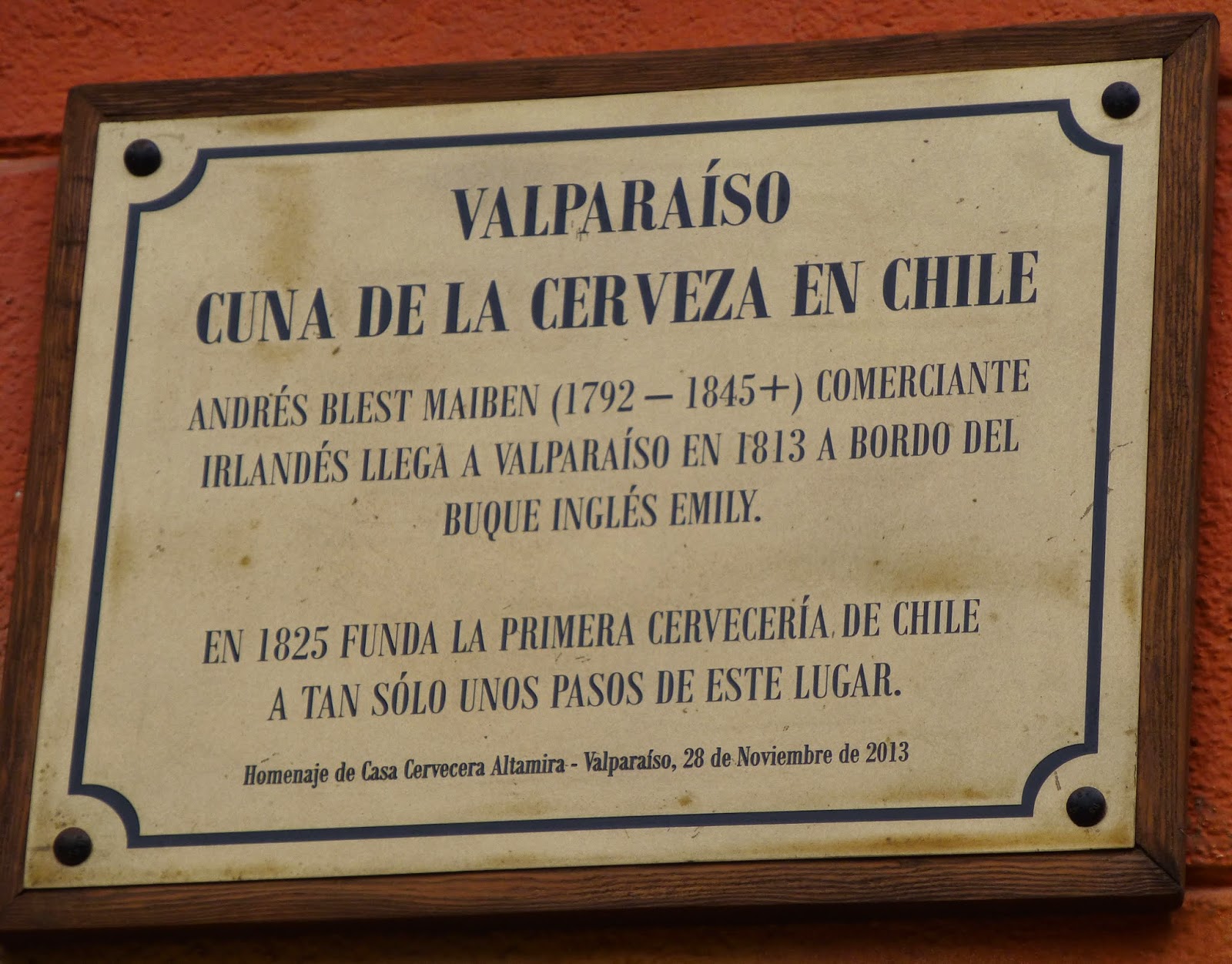
We passed a beer store with a plaque honouring the Irishman who established a brewery on the site.  It says that Valparaiso was the birthplace of beer in Chile.


Nearby was a flower market and accompanying street art.

Flower market

We watched the micro buses for a while.  Each bus has a big sign in the window indicating the route and destination.  They are fast, efficient and inexpensive (about 75- 80 cents CAN) and travel throughout the hills and El Plan (the flat part of the city).

The old trolleys, some of which date back to the late 40s and early 1950s only travel on one route in the flat part of the city.  Alano really likes busses and trolleys, so he's enjoying the transit scene.

                                                                   Antique trolley
We then went to Empanadas Famosas, a 52 year old empanada joint, where the locals hang out.  We had baked empanadas de pino (beef with onions, an olive, and a hard-boiled egg), our favourite and the Chilean specialty.

Empanadas Famosas

Inside signage

                                                                        Enjoying an empanada de pino 

We stopped for a coffee at the Cafe del Poeta, and took a photo of the two great Chilean poets (mannequins, anyway) inside.


We then headed to our rendezvous with our chef.  There was a new boat in the harbour- Sunny Bay.

                                                  Lots of big boats come and go in the port
We met Boris, our chef, and Claire and Phil, a young couple from London, England who were also taking the cooking class.  We got on a bus and went to Mercado Cardonal, a very big fruit and vegetable enclosed market.  There used to be another market more centrally located, but it was severely damaged during an earthquake.  A number of the stalls had closed for the day, but there were a number still open and Boris took us to his favourites as we shopped for our dinner.
Fruits and veg galore
Boris buying eggs from guy who sells eggs and dog food!
Corn and lettuce

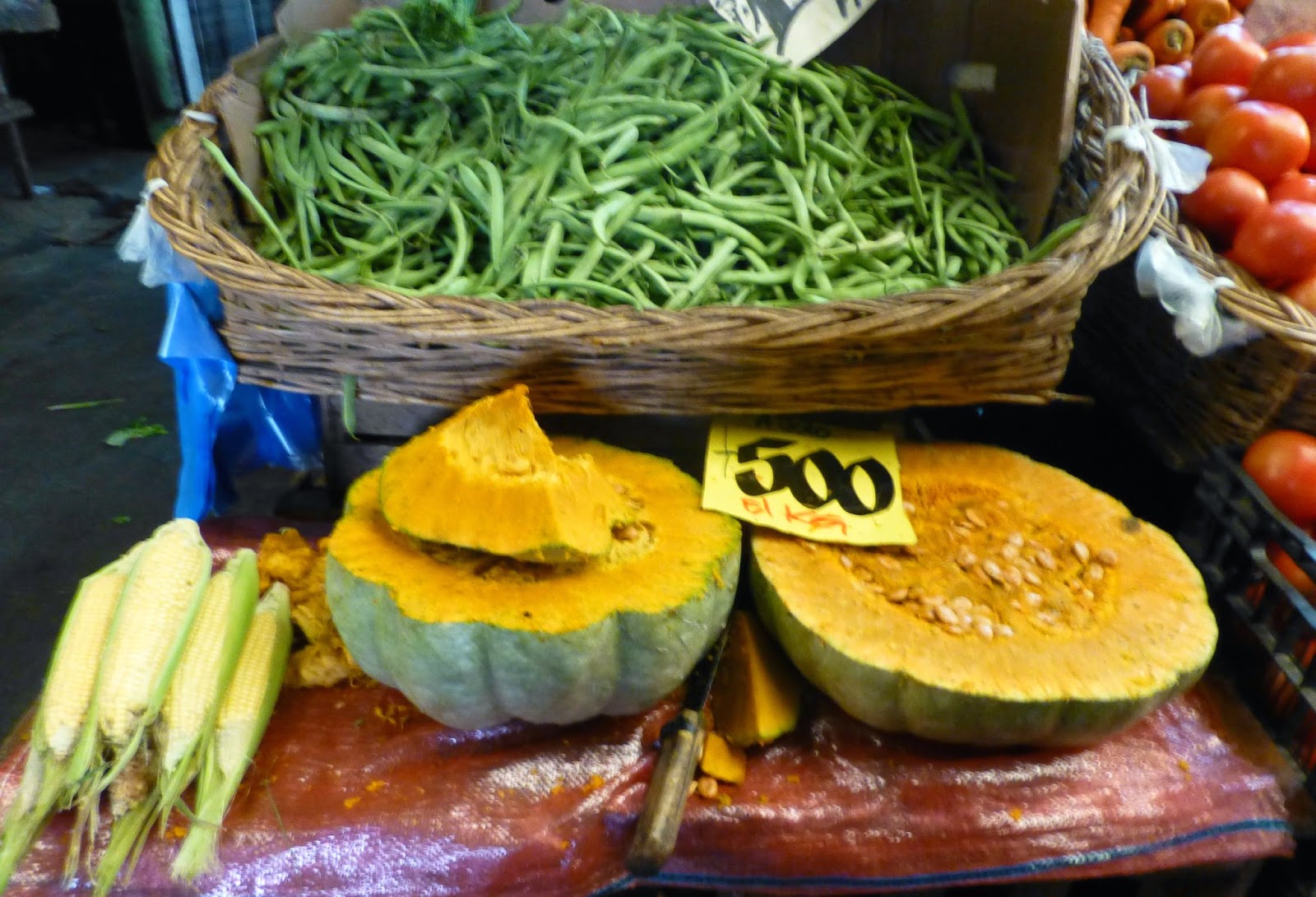
                          Lots of bean and squash


The market building

Limon de Pica Fresco (small lemons for our Pisco Sours)

Tunas Dulces (like a prickly pear plant) for dessert

 Fish store outside the market building- mussels are big in Chile

We walked by a truck full of onions near the enclosed market.


The largest celery we have ever seen

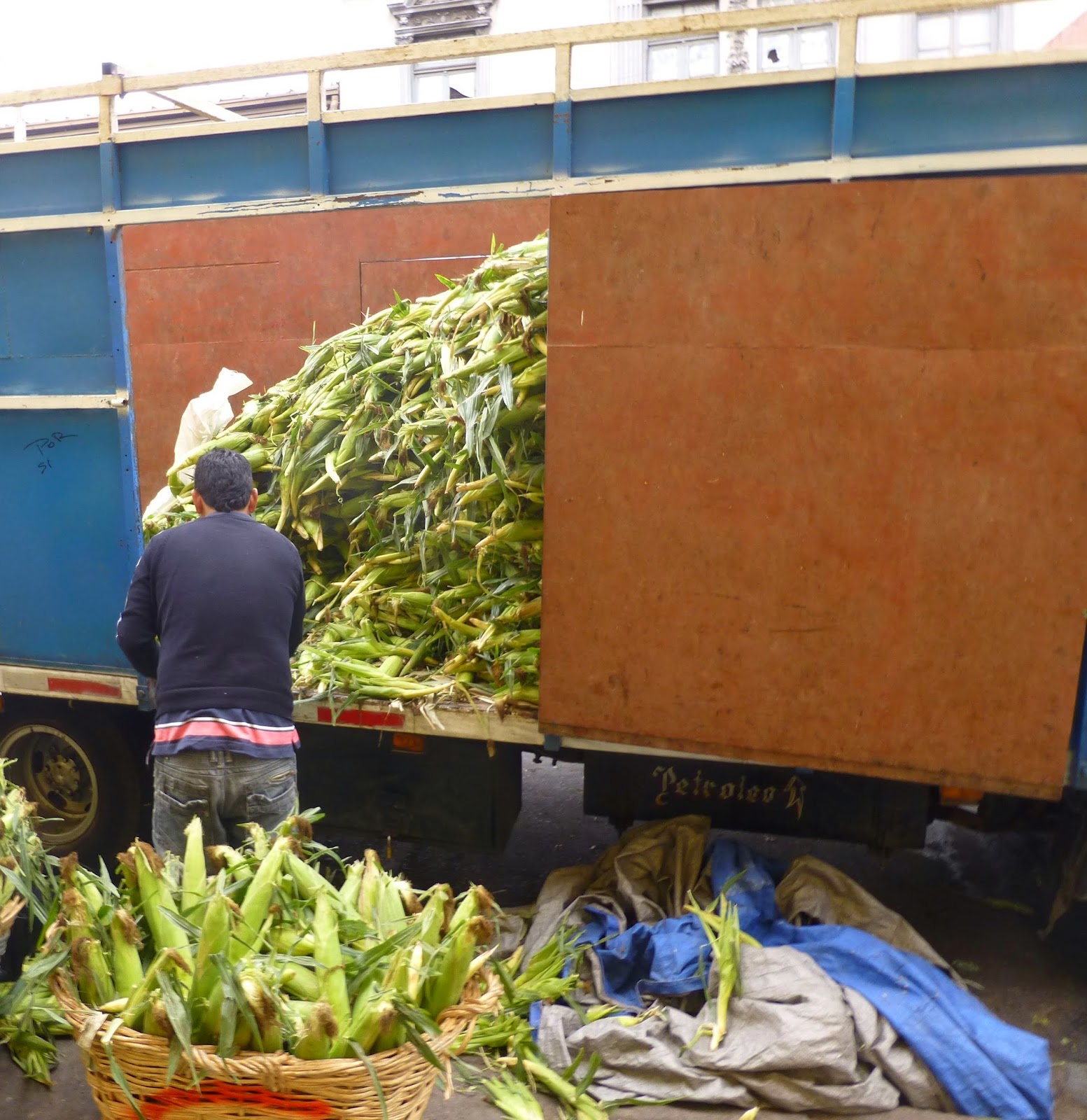
Corn right from the farm

We then took another bus to the cooking school which is located in an airy apartment not too far from our B&B.  We first had a wine tasting with one white and three reds from the nearby Casablanca Valley.  It turned out that the school's wine supplier was the store we have been buying our wine from, located near the Naval Museum.

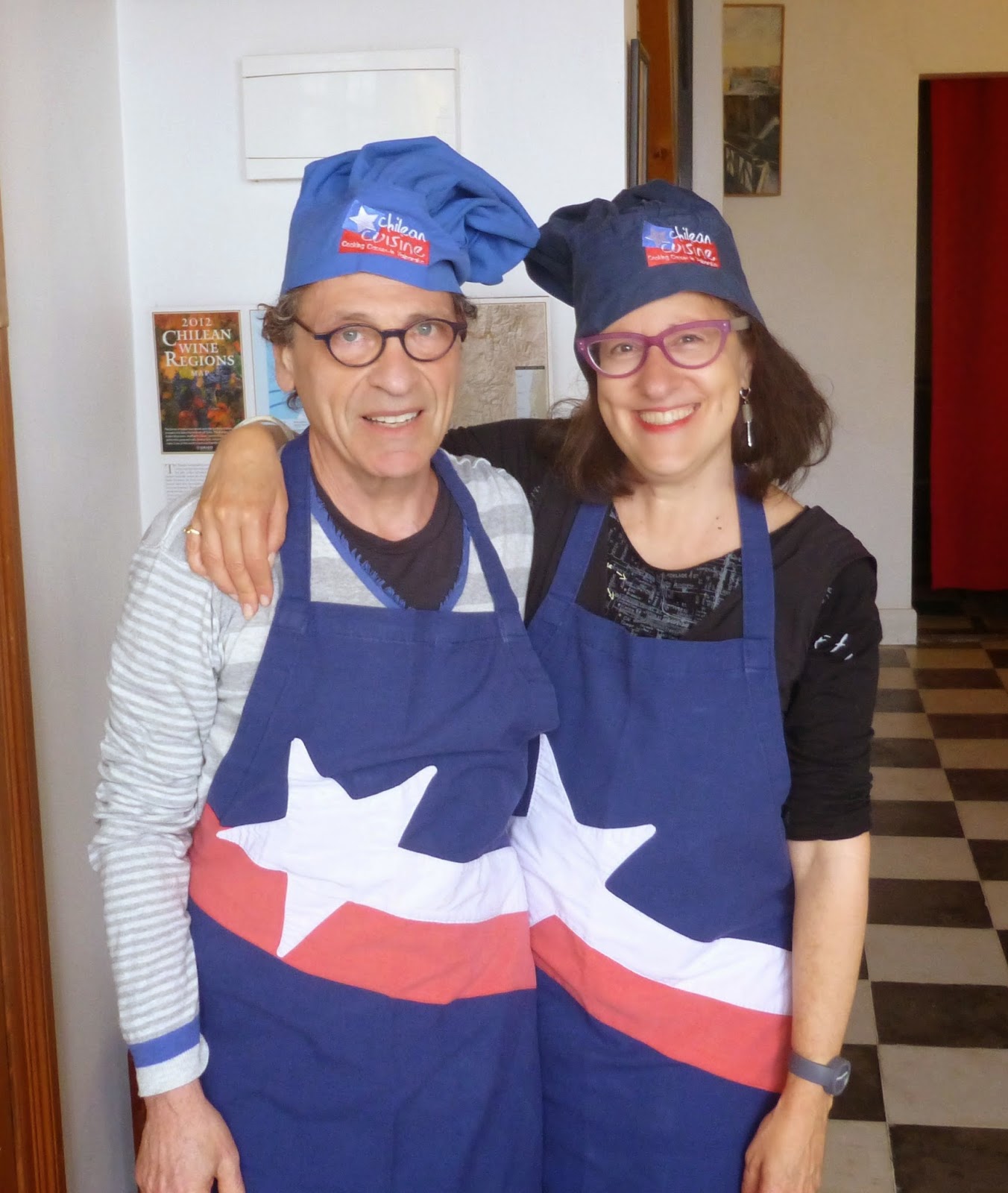
                                    Painted wall and dining table with aprons and chef's hats set out

                                          Three of the wines we tasted; a merlot, a carmenere and a cabernet sauvignon

Boris, our chef, with the wine

                                                                     Getting ready to chop!


At work!

Gorgeous basil, cilantro and tomatoes

                                                       Phil, Alano, me and Claire-The Team

There was a neighbourhood cat who watched us from outside the window.  Boris called him "nightmare".  He went nuts when we were making the ceviche.  He had a lovely black tail to go with his white body.

                                                  Cat watching everything from outside the window

Our meal consisted of ceviche, empanadas pino and queso (made with goat cheese), salsa (known as pebre), small portions of pastel de choclo (the corn with chicken, beef, olives and egg dish we like) and fruit for dessert.  We had pisco sours just before dinner and wine with dinner.  Boris worked around my lactose intolerance.
                             
With the corn for the pastel de choclo

 Shaking up the pisco sours

                                                                        With the ceviche ingredients


                                                  Phil and Claire with pisco sours in front of empanada dough

Pisco sours too!

Empanadas ready for oven

We finally sat down for dinner and ate all the food we had prepared.  The ceviche was totally awesome as was everything else.

                                                                               Ceviche

Cooked empanadas next to pebre  (salsa)

Pebre is a spicy salsa mixture made with tomatoes and onions and a spice blend called "Merquen", which is a spicy pepper of Mapuche origin made with dried smoked chili peppers.  At the end of our class, Boris gave us a small amount of the ground spice blend as well as a whole pepper which has a wonderful smokey flavour.

The class ended at about 9:30 p.m.  We shared a taxi with Phil and Claire who dropped us just a block from our B&B.  It was a wonderful experience and Boris, a former dancer, was a great teacher.  We even learned a family secret- to put white wine in the empanada dough.

For more info check out www.cookingclasseschile.cl    Boris sent us all the recipes we had made  and many more by email today.  If anyone reading the post is interested in the recipes, let me know.